Showing posts with label Appalachian. Show all posts

Monday, February 10, 2014

Interpreting History Mystery Mondays

This is a former post I wrote on January 15, 2012. It was before I had to quit my job because of all my illnesses 2 years ago. I am posting it again. Why? This post referred to some research I was working on at the time of a woman named Jenny Wiley and her being taken captive by Native Americans in 1789. The county officials were trying to get a historical marker dedicated to her in our county. I was interested because having been aware of some Native American ancestry in our family, as a child hearing and reading local history books, I couldn't understand the barbarity of these stories. How could anyone do that to a family? We were taught about these incidents in school. In school, Indians = "massacre", savages scalping and all the ugly these stories produced. When I talked to my mother, she said that there were two sides to every story and one day I would understand it was a war and wars are never pretty.  I saw Jenny Wiley's story as a way to finally understand, and to learn the why.

For the last year, I have been renewing my interest in the story of Jenny Wiley (it never went away!) and it is a real conundrum to tell her story. The basic true history is that on October 1st, 1789,  Native American Indians descended on her cabin, in what is now Bland County, Virginia, killed 4 of her family members and captured Jenny Wiley. She was held captive in Kentucky, where 2 more of her children died and she escaped. She and her husband Thomas Wiley later move to Kentucky and have five more children. Those are the accepted facts. It's the details and the why that need further research.

There are so many versions of her story!!!  I had been working on trying to prove or disprove all the pieces of these various stories using primary documents for the display at the museum.  I really wanted to know what was true and to understand why this happened to her family and this time period in Appalachian history. What I had uncovered is that the real people connected to this story are much more complicated and so much more interesting than the history books have written about to date. But with each piece of evidence the mystery of Jenny Wiley for me grew. I am more than ever determined to inspire research to go deeper to understand her story, discover as much of the real story as we can and of ALL the people of this time period in Appalachia in which she lived.

In the next couple of weeks, I will be writing several posts about Jenny Wiley. The first will be what the different versions of the stories are and then what I have uncovered in the primary documents to date. What I can say is that she was a very remarkable woman (more than the history books give her credit for) and through just her story alone, I think are all the elements to understand the "why" and the truth of the time period in which she lived.

But there is SO MUCH more research work to do. I hope there are some researchers, Wiley family researchers, Harman family researchers, or families connected to this specific area out there that can help to pull actual primary records and put the pieces together further. This is the importance of genealogists. Genealogist are interested in every document related to their ancestor and it is those documents that tell usually the official story. You combine that with oral history, popular belief and even tell the controversies to at least get a rounded picture of the events. I have most of all the "historical" written articles. I'm hoping researchers will look for primary documents that prove as much of the articles claims that we can. I would also welcome some help from Native American researchers and historians. Seems there is a belief that Jenny was descended from Native Americans. Doesn't that change the story a bit if it is true?

I am disabled and limited so much. No energy and brain fog is a big problem plus in traveling for the research. There is a lot on line but much more is NOT!  I will be posting every source I found and scans of primary documents that we have uncovered here in Virginia. That is why I am posting this again about interpreting history. Because 2 years ago I was having trouble proving some of the written "official" versions of her story. Several things appear quite contradictory in the primary documents with new documents just deepening the mystery. But to me, the real mystery and history emerging is much more compelling and exciting.

I will also use the Geneablogger's guidelines. Jenny Wiley will be Mystery Monday posts and I don't know how many it will take.  I finally found my list for the Geneabloggers format that I printed out. It is now in a file folder next to where I work. I love their format though my illness prevents me from being so prolific a blogger! This is going to be a big push on what little energy I have to get these posts out about Jenny Wiley. So please bear with me and if something is not clear or a problem, please feel free to contact me.

It is my understanding the county is still looking to put a marker up and Wolf Creek Indian Village and Museum wanted to work on a display dedicated to Jenny Wiley and that time period.

Interpreting History Originally Posted January 12, 2012

Historians discover, collect organize and present information about past events. I am a historian. I have a passion for history. But it is a passion rooted in my own family tree which expands to tell the story of others. I research to understand what my ancestors lived through. To understand how our world became what it is today. Today research is much easier than when I first began. In the beginning I chased census records on microfilm and reference books at different libraries. A trip to Richmond was always on the agenda for Virginia Census because all the microfilm was in one place. Today with Ancestry.com all the census records are available in one spot, reference works are online and you can access all of them at 3 in the morning! Libraries are digitizing collections and making them available more and more on line. I love it. But all of this is coming together and in the process primary documents are surfacing that tell a different view of history than what was first written or believed.

The last few months I've been researching a very local event to tell the story of the relationship of Native Americans and Europeans in Appalachia especially during the Indian Wars before, during, and after the Revolutionary War. Most like to avoid this time period. It's difficult. Historians of the past recorded "Massacres", with heroes and heroines usually not Native American. Most of the written story themes usually go, "The savage Indians descended upon unknowing colonial settlers for no reason and murdered them."

In my research what I am finding is the relationships between Native Americans and Europeans in the East and especially Appalachia were much more complicated than that. Different tribes in the East could be allies or enemies of both the French, English and the newly formed American colonial government. Certain factions of the same tribe could be allied with two different sides of a war in the same battle.  Depending on the year and events alliances in Appalachia, (and I'm sure this occurred elsewhere) could change depending on treaties or on the atrocities committed. Add to the fact that there were many intermarriages with Europeans, and it becomes a very difficult story to tell. Everything is not Red or White.  Before the removal of the Cherokee there was this attempt by many on both sides to work out the problems of Europeans taking Native lands. After the removal of the Cherokee and movement further west, the attitude definitely became more "the only good Indian, is a dead Indian" and round them all up on a reservation if they are allowed to exist.

What is more upsetting is the passion people feel when you change the history written by former historians and long held beliefs. Especially by historians of the 19th century. Many take much of this history written about Appalachia as gospel truth and have repeated and cited popular stories over and over again. We are learning with all this new evidence made available because of the Internet with more sources, which also helps to lead researchers to archives and courthouse primary documents not on line, many times it is not the complete story and many times not even the truth.

But a popular story provokes quite a bit of emotion if a present day historian tries to correct the record. This happened to Mary Kegley in her research of a story of local heroine, Molly Tynes. Molly Tynes was a young girl who supposedly rode a horse during the Civil War from Tazewell, Virginia to Wytheville, Virginia to warn Confederate Soldiers of a Yankee invasion. It was so popular a legend that folks in our area formed and enjoyed Molly Tyne rides following the supposed route. People just loved that story.  Mary published a book, "I Like Molly Tynes, whether she rode or not", thoroughly researching the event and the beginnings of the story. In her research, Mary could cite no real evidence that the young lady ever took the ride other than one newspaper article in the late 1800's written by her brother who liked writing embellished stories. Many in our area were in an uproar over her research and she is considered one of the top historians in our area. They accused her of historical revisionism.

Historical revisionism is a valid practice of history. As a historian reexamines past events and uncovers new documents, new primary sources, new interpretations can be told.  But it's hard because what was once the standard belief becomes discredited.

Yes revisionism is sometimes used in a negative way. There are those unsavory historians who invent sources as a type of propaganda for a biased history. But true constant revision of history is a part of the normal scholarly process of writing history. New evidence such as a diary or letters that had been in a family or primary documents buried in court houses or archives for years surfaces, to shed a different light on an event. For a historian to ignore them and go with the popular story is irresponsible of a true historian.

This is where I am today.  I'm finding many inaccuracies that were written especially concerning events related to the relationship between Native American actions and European actions in Appalachia throughout the wars between them. There are two sides to every story.  Being in a profession (museum curator) where it is important to tell as accurate an interpretation as you can, as unbiased as you can, this is going to be a task and a half. I can think of a few who might be upset. I'm going to rely on the records and let them speak for themselves. I'm going to tell as much about the individuals of the events as we know through the primary sources as we can glean and let it tell the story.   I'm thinking of the beginnings of the movie Braveheart when the narrator says, "I shall tell you of William Wallace. Historians from England will say I am a liar, but history is written by those who have hanged heroes."

Thursday, May 2, 2013

Dandelion Wine!!! Whoo HOO it's Spring! Uh...I mean Dandelion Jelly! Recipes!

Well hopefully ya'll can read this. I promise I will work on this design thing on this blog. First I forgot I had a blog then I felt a little like Dennis the Menace with a button that needs pushing. Wowwww!!!.... lookey, new design plates on Blogger!! Click! Oh...Crap!!  Have not a clue what I am doing but I will learn. Unfortunately anyone reading this will have to suffer until I figure it out! If your looking for the ditsy Appalachian historian who has CFS...you are in the right place!

Now let's talk Dandelions!!! While most people are trying to kill dandelions in their yard, we don't! That's food and medicine.  Yes, John Boy there is more than one type of "recipe".


You can fry the blooms and eat them with eggs, you can eat the leaves like a salad, or you can pick the blooms, process them and make jelly and WINE!  I'm going to post my two favorite dandelion jelly and dandelion wine recipes at the end of this article.

I looked out the window a couple weeks ago and just saw a sea of huge yellow flowers in the yard. Just about covered the whole yard. Now dandelions grow but this "sea" usually happens when the cicada's are coming back. They come up out of the ground and I believe they aerate the yard or something making dandelions get big yellow blooms on them. I was inspired.

I hadn't made anything out of dandelions in YEARS!  One of the last times was when a girlfriend and I decided the dandelions on the municipal court lawn in Radford were the prettiest, largest blooms we had ever seen.  We grabbed a bucket, bent down on hands and knees and waved at all those going to court while anticipating our future dandelion wine. That's been some years ago! Now it's all the rage to kill dandelions and if any were to show up on that lawn today they would probably be poisonous. Be careful where you pick.

Now with my illness I have to do this in stages. Modern appliances help with this. Not unusual to hear at my house, "Mom, what's this bucket of Dandelions in the refrigerator?"  So I pick them one day and rinse them, process them the next and boil them, then cook the juice into what I want another day. If it were not for this in stage stuff, I'd never get anything made in my shape. But if you have the energy in an afternoon you can have jelly and wine in process.

My grand daughter helping me pick asked me, "Granny, what are you going to make with this?"  "Why I'm gonna make WI...uh...Jelly, little one." She's six so she was calling my jars of jelly Wi-jelly until I fessed up that we also have a small bit of wine brewing.
Blooms Boiling in a pot NO GREENERY!

Now the trick to dandelion jelly and wine is you ONLY USE THE BLOOMS! NO GREENERY! This is a pain in the butt to have to process but worth it because otherwise your jelly, wine whatever comes out a bit bitter. I like to gather just the blooms and rinse them under water. Kind of funny because sometimes the cold water hits them and they will just close up. I take scissors and cut off the base of the flower and then pick the green part from the petals. Put the petals in a measuring cup so I know when I can stop. LONG PROCESS. An ice cream bucket full yields enough for jelly or wine.

Greenery left after a bucket full of processing. Makes my fingers hurt!

The jelly reminds me of honey and you have to use a pectin to make it jell. The wine...just reminds me of warm days. I like to keep some back just for winter, makes you feel warm just thinking about making it.

Here are the two recipes I use:

Dandelion Jelly

Pick enough to process and get 1 quart of bright, fresh, dandelion blossoms. Rinse them quickly in cold water to remove any insects. Using scissors, snip off the stem and remove the green collar under each blossom.
In an enameled saucepan, boil the dandelion petals in 2 quarts of water for 3 minutes. Cool and Strain, pressing the petals with the fingers to extract all the juice. Measure out 3 cups of dandelion liquid. Add 2 tablespoons of lemon juice and 1 package of powdered fruit pectin (1 3/4 ounces).

Add 5 1/2 cups of sugar, stirring to mix well. Continue stirring and boil the mixture until jelly stage. A candy thermometer works well here unless you are like Granny Burress and can "smell" when it's jelly.
Pour into small glasses and cover with melted paraffin when the jelly is cool.

Dandelion Wine

 Ingredients:
1 quart processed dandelion blooms
1 gallon boiling water
1 package active dry yeast (.25 ounce)
8 cups of white sugar (I've used as little as 5 and it came out fine)
1 orange, sliced
1 lemon, sliced

Pick enough to make 1 quart of bright, fresh dandelion blossoms processed. Rinse quickly in cold water to remove any insects. Process using scissors, snip off the stem and remove the green collar under each blossom until you have 1 quart (4 cups).  Heat 1 gallon of boiling water. Place dandelion blossoms in the boiling water and let boil 4 minutes.  Strain, pressing the petals to extract the juice.  Let the juice cool to at least 90 degrees. I test it like testing baby's milk.

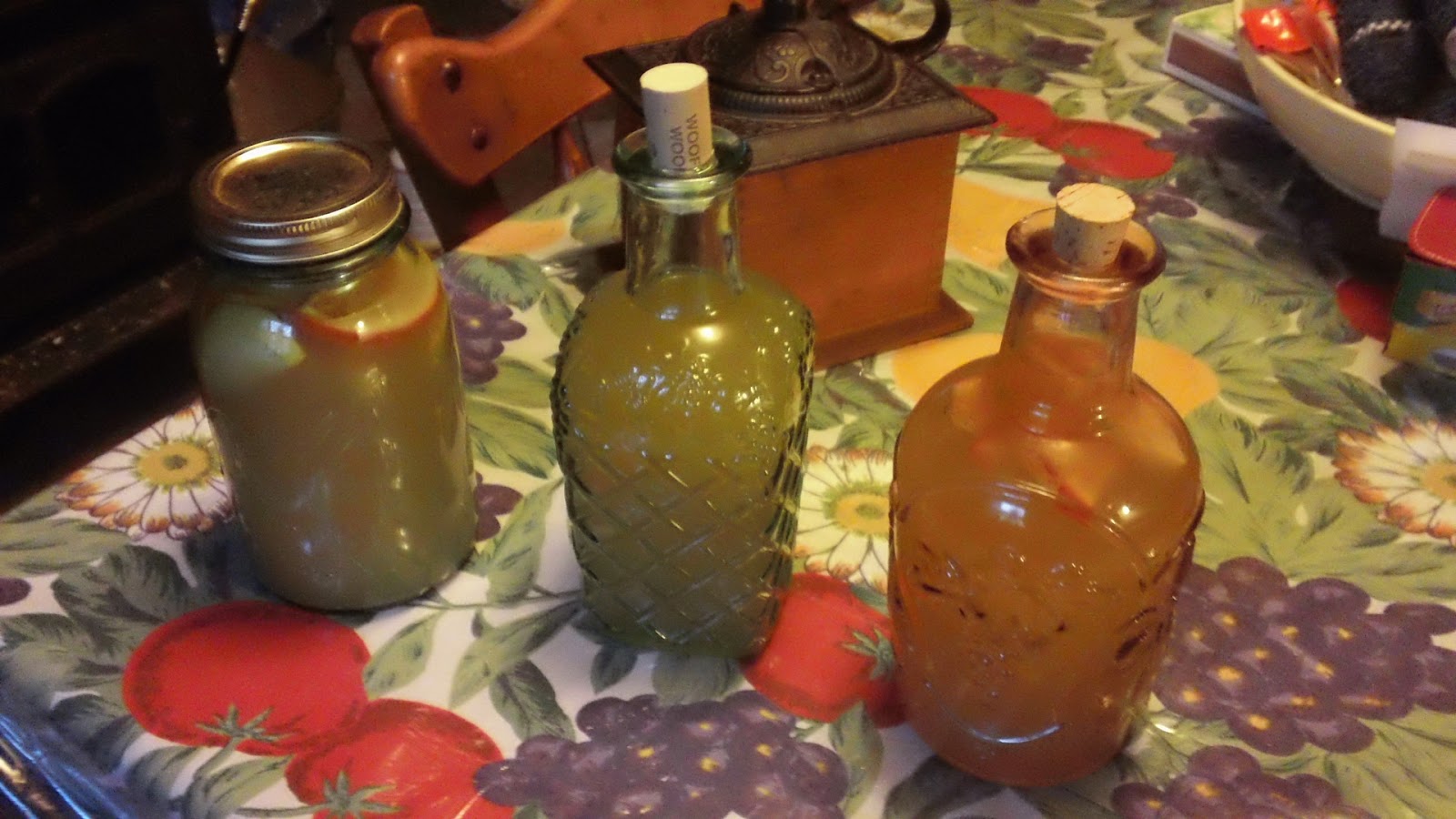
Stir in the yeast, sugar, orange and lemon slices. Pour into either plastic gallon jugs or a 3 gallon crock or you can get fancy and use a plastic fermentor with a lock. If using jugs put a balloon over the mouth of the jug. It will expand. For my crock I just use saran wrap loose or even a garbage bag tied tightly. In the old days they just used a crock with a wooden lid or a barrel with a cork. Just keep it in a cool area for a couple of weeks until the bubbles stop.   Siphon the wine off of the lees and strain through a cheese cloth before bottling. You can use quart sized canning jars with rings and lids, an old brown jug, or old wine bottles. Best to age the wine for at least a couple of weeks if you can't wait. I leave mine as long as I can. Always consult your state laws on winemaking. Click Here for Virginia Laws

Hope you can enjoy your dandelions. Have any questions contact me.


Yep it's fermenting!

Now I share my recipes freely. And I copyright my words. You try to make a living on it and a pox will be heard!

Put Your Back Into It, Save your Strength!

The other day I was looking at something on the internet and came across my OWN blog! YES, it's been that long since I've even thought about it. I sort of forgot I had one. Which for me is normal these days. My illness does keep me in a "brain fog" most of the time.  As a matter of fact my illness (s), (there are more than one) have taken up most of my life these days....and to tell the truth...I'm tired of sickness taking everything.

I am a shadow of my former self. I've spent my time trying to figure out how to live with these disabilities. What can I do now that my body is really messed up? What can I not do, that I used to do so easily? I am learning I can do things, just in small chunks not long marathons. If I try to do a marathon....well then it's going to be a marathon recovery for DAYS. I can work eight hours as long as I'm given 24 to 36 hours to do the eight in! 

My days are full of trying to accomplish one or two things, then rest, do something else, then rest and hopefully at the end of the day not be in any pain so I can sleep which is a whole other problem. So many symptoms it's boring, daunting and sometimes downright depressing.

But in trying to deal with this new life situation something came to mind. I'm the family historian and I've still work to do. How do I do it in this shape?  I remember my mother loved to rearrange furniture at least once a year. I might rearrange once in a blue moon and I think that is because in my childhood, being a military family, we moved all the time. Add mother like to move furniture just for kicks and there you go.... once in a blue moon was enough for me. I have scars for life because in doing this task she would require all us children to help.

Dad did not participate in the moving but would notice this moving of furniture when he came home late at night and tripped over something that had been somewhere else when he left. 

Yet I remembered in the moving of the furniture my mother was quite creative. She would use blankets placed under heavy furniture on a wood floor and we would slide things in place. She would take anything on rollers and use it as a dolly. One plant stand comes to mind because we would have to wrestle the tree off of it and use it and then it took three of us to put it back!

But one thing she would tell us instead of using our arms to push something heavy was to, "Put your back into it, save your strength". Meaning place your back against the furniture and push or use your hip not your arms.  Well with these disabilities, I feel as if it is like moving heavy furniture with even the most mundane tasks.  I just have to learn how to put my back into it and save my strength. Do what I can do the best way I can. Find my blankets and roller plant stands and not to worry about how it looks just as long as things move!! 

We are an OLD Appalachian family with many, many stories. The blog has a draft mode and I can use that. But I have boxes of stories to tell. Thousands of pictures to share. Piles of research I've accomplished in 30 years. Tons of topics to explore.

I started this blog with the intention of telling those stories of family and places I know. Well I still want to do that. So what if I only get out a post a month or every other month? It's the effort that matters. I'm not dead yet...just sick. I can still live with that!

Thursday, April 22, 2010

Gentrification of Appalachia

Appalachia is changing. Has been for some time.  I know there is no one stereotype of Appalachain people. But lately I've noticed this dogged undercurrent of a big getting away from any mention of the old ways especially about outhouses and the way we lived and referring to it as being so substandard. People, especially those new to Appalachia, wanting to see our history distanced from a past that frankly was just the way it was before they brought money here and a demand for good plumbing.  A tweaking of this ideal life for what Appalachia is or isn't for folks.  It just depends on who you talk to.
The Appalachia my family knew was just different. We were not rich people, we were salt of the earth people. We used an outhouse because there was no septic system or city sewer system. Many places the ground was so rocky with so much clay they couldn't have put a septic system in even if you wanted to.

Just within the last ten years I have hooked the old 150 year old house to a public water system. We finally disconnected the old well. This was not just a matter of rich or poor but more of what was available. But in my lifetime I've been in some fancy houses that had lousy plumbing in Appalachia.

I can remember carrying good water in jugs from a spring when I was younger in the early 1970s. The house we lived in, though it had a well and a bathroom, it was IRON water. Turned all your clothes orange!!  And the bathroom froze up in the winter despite Dad's best efforts. He put in an outhouse for emergencies.  It was not a bad way of living just different and we coped with it. Some folks had sulfur water that smelled like rotten eggs and would clog up pipes for the same results. But an outhouse built character is what my grandmother said. Some homes didn't have well water they had gravity flow water off a hill and went into a cistern. It was not only the monetary resources of the people but the geography of the mountains that produced the stereotypes of living conditions.

But I went to a meeting the other day and it was among people who are trying to save the heritage of our Appalachia and create a tourism market in Appalachia.  What struck me the most is here were people talking of the mountain music, arts, crafts, history and wanting to celebrate that by speaking of wanting to change the stereotype of Appalachia such as everyone lived in a house with an outhouse in the old days. They wanted to change the perception of Appalachia from the barefoot children going to school and the backwoods downtrodden folks to one of gentility instead. I kept thinking every community I have researched family history in had barefoot children pictures in school. So now we don't want to show "that part" of Appalachia, even though they existed and it was real. OK.....mmmmm   And it's because we are trying to "sell" the Appalachian experience. Ok.... what the heck is that?

Well see now there are artisans now taking up the Appalachian crafts, (I applaud those folks for that) and are creating a semi quasi mythical way of life, creating art studios and art trails. But the wonder of it is very few of these folks I have talked to are people actually from Appalachia.  Many have Ph.ds and just want this simple way of life that they think Appalachia of the past represented. Yet they have changed Appalachia by coming into the mountains. Mainly because they are not content with doing without modern amenities. So they moved on a mountain top and then brought money to demand decent plumbing and trash pick up and roads. It's been amusing to watch.

But what I really find questionable is many want to make this extraordinary living at the old Appalachian "arts" or even small farming while changing the view of Appalachian actual history. It's not a bad thing to have this diverse economic growth. We have goat people, and alpaca's, and ostriches with sheep and wineries. Very odd to walk through the mountains and run up on an ostrich! 

But I recently saw a "chair" artist. He made split oak chairs much like my great grandfather did. Wants a pretty penny for them too, $300 and up each. Is it worth it, probably if you don't want to have the pride to make it yourself, but looking at his work and remembering the old chairs around the family, I don't think he took the care that Grand dad did with making his chairs.

And wineries, there were many in the mountains who made there own brews. Just wasn't as commercial though we had a quite few small business commercial operations.  There was actually a small winery in Bland County ran by the Justus family. But we mostly made our own. I ought to pull out my aunt's dandelion wine recipe. (I once made a batch collecting dandelions off the municipal courthouse lawn in Radford VA. Prettiest crop of dandelions you ever saw that year.)

This is the difference, these new chairs, these new wines, are for money on an economic level that just never existed here in the mountains much. I had an uncle who ran a mill and for grinding the corn he would take a percentage of the corn not coin and then would sell it sending it by train or wagon east and south. It was more of a barter system that I am aware of. And of the chairs,  Grand Daddy made his chairs because he was too poor to purchase Grand Maw store bought ones. He would "trade" making a chair if he found something to trade for. We made do using the resources we had...and in the process, was artful in how we made do. The myth and simple life they want, the newcomers are destroying because they don't understand it came with an outhouse and bad plumbing. It came from a more barter system of community. It came out of necessity.

We provided for ourselves something useful like a quilt out of the best part of a rag, something beautiful like a hand carved box out of left over wood, or created music that sounded sweet or sad or made you want to dance. That's what made it different, that's what makes Appalachia special. It was born out of hard times, not good times. Out of real life, not easy street or the rich parlors of the coal or railroad barrons, but on the side of a mountain in a house that could be called a shack today. I wonder what picture they would rather have on the wall with a quilt in a museum exhibit. A ranch style brick?

Now, our children are buying in to the modern life. What will they learn of their own history? Will the story be we never had to make what we needed and we all lived in real fancy homes and only made chairs for art sake. It's second nature. We have indoor plumbing and water now. The cross cut saw is hanging in the shed, rusted. We go to Walmart and Lowes and no longer have to travel a long distance to get a stove. They won't know that we ordered from Sears and Roebuck the fancy things and pick them up off the train. Our children don't know about going into town only on Saturday. By the way, those that lived in town, yes, they might have had indoor plumbing in some of the houses but right next door you had an outhouse that could be visited by a tanker truck in the late 1970s to pump it out!


Appalachia has changed and is changing and now to tell our story they want to get away from the reality of the circumstances that existed for many of our Appalachian people that created the real art of Appalachia, the flavor of Appalachia, the one they sort of want to mimic for big bucks.

At that meeting there was a comment that people from the mountains are "ashamed" to say how they lived so we need to steer clear of any exhibit that puts Appalachian people in a stereotypical light such as with an outhouse.  That statement made me feel hurt and ashamed that we have to change what I know of my own family history just to please...... who? and I wanted to scream OH FOR HEAVEN'S SAKE, HOW STUPID CAN YOU GET!!!  I think we ought to embrace every bit of our history and all the things that made us different even the darn plumbing!!! If you are going to tell the story and get the "flavor" of Appalachia that is a BIG part of it.

This Picture is of Grand Dad sitting in a homemade split oak chair, in a house with gravity flow water and an outhouse, in June 1961, just on the outskirts of Bluefield WV.   THAT'S REAL APPALACHIAN HISTORY FOR ME!!!

Wednesday, October 28, 2009

What to Post on a Blog?

As I see this the world has much in common but Appalachian people definitely have their own take or view of it. We are said to be "funny turned" referring to creating a spindle or leg of wood on a lathe that doesn't quite fit with the other legs of a chair. Good enough analogy. I just realized this endeavor is going to be some work to it. This is not as easy as I thought it might be. But it will be interesting.

I will try to focus on one subject at a time but life crosses over and it's amazing what you learn while doing something else. Maybe it would be best to create an outline and see what works and what doesn't. Might sit down tonight and tell a couple of the old scary stories I remember (if I can remember them) that grand daddy Burress told sitting under his hickory tree since it's Halloween this weekend.

Later this weekend I will start with a craft. How about good ol' Corn husk dolls? It's fall. Then maybe the Civil War since I'm trying to unravel this story of a grandfather that is pretty tragic. Then how about an article on old versus new Appalachia? This high speed is awesome though we did not get access to it until last Fall.

Tuesday, October 27, 2009

Appalachian Heart Wood

Welcome to my blog. I am new to this. It was hard just trying to figure out a name to call the blog. Heart wood....the center of a tree. Strong and fine grained. Good "nough". I'm Appalachian by heritage. That is a deep subject in itself. I live in the heart of Appalachia as have nine generations before me on one family branch and Lord knows how many generations on others. But don't hold that against me. My grandfather told us that these mountains and waters were our blood. Not in our blood but "our blood". My family has seen many changes in the mountains. We are still seeing them. It's quite a bit to ponder. Since cold weather is upon us and winter is coming on soon and we have that new high speed internet...time to make it pay for itself and get some use out of it.


This blog will be for history, genealogy, issues that affect me and mine.