Showing posts with label Appalachian Indians. Show all posts

Friday, February 21, 2014

Where was the Cabin of Thomas and Jenny Wiley in Bland County? Mystery Monday Post for Sure!

This post is going to be a long one just with the documents! I was going to set the stage with a lot of historical background. But I instead will just mention as I go along a few items that affected land grants.

Folks, please forgive any errors. This little foray into Jenny Wiley has sapped all my energy, taken all my spoons and will take me a great while to recover from. Seriously I'm not going into great detail of the actual background history but will post a short bibliography for those that should pursue more information to understand how your ancestor could be on the frontier in central Appalachia in the 1750's and yet not get a land grant until the 1780's and beyond. If I get my strength back and my mind will work, I will try to do a couple of more in-depth posts about the Loyal Company grants, the impact of war and treaties on the settlers here in our part of Appalachia. But I want to get to what I promised, because I want others to take it and continue on with the research that I can no longer do.

If I don’t do anything else before I leave this old world, I want to inspire others to get the history right about Native Americans in Appalachia, the settlers in Appalachia and the relationships between the two. That to me would be a lasting worthwhile accomplishment.  I hope these posts will inspire others to get out there and accomplish the research of the real Jenny Wiley history.

The capture of Jenny Wiley and many other attacks on the settlers in our area occurred long AFTER the Revolutionary War. England has lost, and the westward expansion goes into high gear.

The lands where Jenny Wiley and my ancestors settled were thought to be under treaty to be ceded by the Indians early on.  The Indians obviously disagreed. In simplest terms, in many cases, someone forgot to inquire of the true Indians that held claim to these lands to give them up or they did and they said, "NO".

In the middle of that fight you have settlers Thomas and Jenny Wiley and the Indians who attacked them. Both protecting what they considered was their right to protect.

Before the Indian Wars in the 1750's, men such as Thomas Walker, who is the namesake of Walkers Mountain, (Big and Little) Walker's Creek and the Walker's Creek Settlement, had petitioned the colonial government for land. Thomas Walker's Loyal Company was issued a grant for 800,000 acres that spread from West Virginia to North Carolina.

It's real fuzzy the boundaries of these land company claims because no one had actually surveyed the entire lot. There was a certain process you had to go through to get the land grants. A survey had to be taken, (which means you had to hire a surveyor license by the courts), it had to be recorded, you had to pay money, live on the lands and develop them and ...then you could get a grant issued at the county or state level. The whole process for the Loyal Company was interrupted by the Indian Wars, the Proclamation of 1763 (which threatened to make the Loyal Company Grants null and void), and the Revolutionary War.  Another problem occurred because there were other competing land company speculators that claimed the same acreage. Add treasury warrants for military service and it's a wonder we didn't have a second war on the frontier after the Revolutionary War.  Later these claims after the Revolutionary War would be held up in court of appeals and land commission cases FOR YEARS to settle ownership.

That is why many of our earliest land grant deeds will mention these cases. It shows how it is hard to determine just how long a European settler would have been here on the frontier using just land records. Some folks such as Henry Harman had his surveys recorded in 1754, but waited 45 years to get his grants in 1789.

Others settlers living on the lands before the Revolutionary War, didn't get even a survey accomplished until the 1780's. Many had actually moved on and had sold or assigned their rights to someone else before getting their own original claim recognized which left the assignees having to prove they had purchased the original claim in courts.

In this time period in Appalachia, you can't go just by the deeds or grants to determine when someone arrived in a specific area on the frontier or where they lived at while waiting for courts to determine land ownership. You have to dig for other primary documents to tell their story.

That is the case in looking for where the cabin of Thomas and Jenny Wiley was located.

As I posted in an earlier post, I was trying to create a map for a museum display to mark the route Jenny Wiley took from Bland County, Virginia to where she was held captive in Kentucky. All I found were conflicting accounts in the written sources everyone referred to that claimed to be the actual, factual accounts of Jenny Wiley.

David E. Johnston's wrote in his History of the Middle New River Settlements that he interviewed William Stowers who claimed that the Thomas Wiley cabin was on the old Dill's Place on Clear Fork Creek. You can find his very embellished text version here on pages 98, 105, 107 and 148. Text Version History of Middle New River Settlements by David E. Johnston 1906
It's an amusing account but just like Connelly's version not researched much in primary documents. (and really? Indians adapted the leather hunting shirts from the Europeans? He has that backwards!)

William Easley Connelly's version in the, "History of Kentucky, The Founding of Harman's Station", has been over the years considered the gold standard for telling the story of Jenny Wiley. Because he states he relied on interviews with Jenny Wiley's son, Adam Wiley. His goes into great elaborate detail of a trip from a cabin supposedly near Mathias and Henry Harman on Walker's Creek.

(Is it just me or were Connelly's footnotes in this story an entire book to itself?)

His version though is very embellished. I also have a problem that he prints his version long after Adam Wiley is dead. Adam Wiley would not be able to refute anything he wrote. He gets confused the Mathias Harmans. There were 3. Mathias Harman, Henry Harman's brother, Mathias Harman, Henry Harman's son, and Mathias Harman, Daniel Harman's son. That family repeated names a bunch!

When I began 2 or 3 years ago I started trying to verify his claims by looking first for the land sale Connelly mentioned of Mathias or Henry Harman's to Thomas Wiley. I collected copies of every Harman grant and found NOTHING. No boundaries that mention Thomas Wiley as even being a neighbor... NOTHING.

I found the Mathias that built the block house at Harman's Station was Mathias Harman, Henry Harman's brother, and his land grants were with his other brother Daniel Harman on the Clinch River...no where near Walker's Creek. Henry Harman does assign his son Mathias, a land grant on Walker's Creek and it's recorded after 1790 in Wythe County but this Mathias doesn't sell Thomas Wiley land.

Even the Harman story of the hunting camp incident in Connelley's version, the reason the Indians are attacking the Wiley cabin by mistake. is hard to place in the Jenny Wiley saga. Henry Harman and his son's are attacked at a hunting camp in which Henry is wounded. They also killed a chief's son. The story is they are going to race back to the Walker's Creek Settlement because they know these Indians are going to want retribution.

The problem is not that the incident didn't occur it's tying it to the Jenny Wiley story. One version has it occurred in November 1784. If that is the case it is five years before the event. Another that it occurred in November 1788, then it took them a year to get back. If it occurred in November 1789, then they were a month too late but all versions agree it happened in November. Makes me question if whether this part of the story, though it may be a true event, was just added to embellish the story to make it a more exciting captivity narrative.

But even the story of Henry Harman deserves much further research. It is said the chief, whom Henry had killed his son, were once serving together against a common foe. The story even says they were once friends. The Native Americans knew Henry Harman, they called him Skuguska. A whole area of research could be opened up just on this man and his times to see, if the story is true, how allies became enemies.

What I did find was a deed to Thomas Wiley for 110 acres of land on Clear Fork Creek issued in 1795.  Thomas was an assignee of Robert Smith and in the grant it mentions that it was an "adjustment to lands in Washington and Montgomery counties", telling me this was settled in a court case. The grant doesn't prove exactly WHEN Thomas and Jenny moved to Clear Fork Creek.....yet. A search, which I did not get to accomplished, for land commissioners records (if they still exist) for this case might produce the actual date. But other records show they were on Clear Fork prior to 1795 and I believe prior to the attack on their cabin.

Robert Smith's original survey was for 300 acres and dated March 5, 1784 and at the bottom of that page it gives the assignment for Thomas Wiley for 110 acres and the survey for 110 acres.
Montgomery Co. Va Record of Plots Book D Part 1 1-286 

It is funny how you jump around in research. After finding all this suspect history in the written accounts, beginning with J. D. Smith's letter to Governor Randolph giving the timeline for Jenny Wiley's captivity as being much less than Connelly or any of the other writers claimed, I started looking for Jenny Wiley's actual deposition. Connelly mentions it and says he relies heavily on it. Jasper Newton Harman mentions it in his Harman Genealogy, even J.D. Smith mentions her deposition in the letter to the Governor which to me makes it official there was a depostion.

I haven't found the deposition but a search is ongoing for it. Wouldn't it be great to have Jenny Wiley be able to tell us in her own words through the actual deposition? Which begs the question, why has no one found this deposition or affidavit? If we find Jenny's affidavit it might clear up the whole question of where the cabin was or where she was when captured! She may have been on Walker's Creek when she was captured for some weird reason, despite the primary documents saying her cabin was on Clear Fork Creek. LET'S PROVE IT!

In that search, I ordered rolls and rolls of microfilm from the Library of Virginia. I was going through Court Order books, specifically Montgomery County Court order books for the 1790s, since that is where J. D. Smith says the deposition was taken. I didn't find any reference to Jenny Wiley. What has been found were very curious court order entries.  Two pages of note, with the first page dated August 4th, 1789, 3 months before the attack on the Wiley cabin. The second page is for the repair and maintenance for a road to the Cove Road up Wolf Creek to Clear Fork Creek.

The way roads were built and maintained at that time period, were by those who were living near or on the road. Settlers would be ordered by the county court to do their part in working on the roads. A surveyor, usually a landowner on the road, would be appointed to make sure to get all the neighbors ordered by the court together, to repair, maintain or build the road. They would also report to the court if someone wasn't pulling their weight or causing problems like putting up an illegal toll.  For more information on the early roads and excellent resource the early lands and roads are the series books, "The Early Adventurers on the Western Waters" Volumes by Mary and F.B. Kegley  Information specifically for roads is in Vol. 1 pages 178-180.

These orders appear to be for a road from Captain Pearis's on New River up Wolf Creek, to the Cove Road on Clear Fork creek. They include Thomas Wiley as working on the road at Clear Fork Creek. Page 71 orders Matthew French as Surveyor and he is to be over the road from Captain Pearis's,  (family the town of Pearisburg is named for), to ten miles up Wolf Creek. Then Charles Hayes Sr. is to be surveyor from Matthew French's up Clear Fork Creek.  Here are the actual scans of the orders.
Montgomery County Virginia Order Book No. 4 1788-1790 Page 70 with the date for page 71
Montgomery County Virginia Order Book No. 4 1788-1790 Page 71

Bottom of Page 71 listing Thomas Wiley and Samuel Sellards with Absalom Stafford.
Montgomery County Virginia Order Book No. 4 1788-1790 Page 71

Matthew French's appointed surveyor for the first group, his lands were on Wolf Creek. Charles Hayes, Sr who was appointed surveyor for the second group, his lands were at the confluence of Clear Fork, Laurel Creek and Wolf Creek at what is called today Rocky Gap.  This county road order in August, 1789 is following what is today Route 61 along Wolf Creek through Giles and Bland County, Virginia to Clear Fork Creek  not Walker's Creek.

In a search for the names in the bottom half of page 71 all of these men had either lands or were related to those who owned lands on Wolf Creek going into Rocky Gap and up Clear Fork Creek to the Cove Road. For example Joseph Baker married Sukie Hayes the daughter of Charles Hayes Sr.  etc. I could list them all but I'm not, I'm tired. The most important one to me is Absalom Stafford.

I found these references in the "Early Adventurers on the Western Waters" Volume II by Mary B. Kegley

Page 49- Commissioners Certificates Book at Montgomery County courthouse on page 86 of that book under the date September 7, 1781 - " Absalom Stafford - Commissioners Certificate 150 Acres on Clear Fork of Wolf Creek bounded by a conditional line made by Thomas Wiley and Thos. Smith."

Page 108 -  In a book at the Virginia State Library Archives entitled " Record of Certificates of Commissioners of Washington and Montgomery Counties 1767 - 1788.  Pg 82 of that book "Absalom Stafford - 150 acres on Clear Fork Creek, bounded by conditional lines made by Thomas Wily & Thomas Smith, settled 1777."

For a really good explanation of these land commissions that were set up to settled land disputes this Vol II EAWW on pages 98-101 is the best!  But it still took Thomas until 1795 to get this land grant. There were further cases after Absalom Stafford and those would have to be tracked down to understand why his was granted in 1795.

What this does show, is that Thomas Wiley's land boundaries were known to land commissioners in 1781 and he is working with Absalom Stafford and Samuel Sellards, his brother in law on the repair of the road to Clear Fork in August 1779.  Part of the condition of these land grants was you had to be living on the lands you claimed.

There are a few folks that will be upset with these revelations. Someone will have to prove to me why Jenny and Thomas Wiley would be on Walker's Creek when they had their own lands on Clear Fork Creek. I have found no instance of Thomas Wiley working on the Walker's Creek road in those years or any other proof he and Jenny were living on Walker's Creek.

So how was it that Walker's Creek became the site of the cabin? Myself and my man were talking about this and we have a theory. In the Montgomery County Court Order books, the Walker's Creek Settlement is mentioned many times. Henry Harman's place at Walker's Creek is listed quite a few times. Walker's Creek Settlement was the place for trade, roads to the Clinch River were ordered from Henry Harman's place and Henry's house was even where you went to vote. Sort of like the folks who live on Wolf Creek at Grapefield today. There address is Bastian but they don't live in Bastian. Walker's Creek I believe was a district address but not where Thomas and Jenny Wiley were living. The stories of them living on Walker's Creek, I don't know their basis in fact. I welcome any evidence to the contrary that they were living on Clear Fork Creek.

Thomas Wiley's lands would have been near the Cove Road. The Cove Road off of Route 61 still exists in the beginnings are just over the county line in Tazewell County and it crosses back over into Bland County at the top of East River Mountain before crossing over.. It is a gravel road that goes through a gap across two mountains and ends up in Bluefield, Virginia very close to the head waters of the Bluestone River. All the accounts say that Native Americans went after outlying cabins for captives. Walker's Creek Settlement would have been more populated and definitely a better armed settlement. Cove Road would have been easy access in and out quickly, it just makes more sense the Wiley cabin would have been a better target there.

This was the first time I had heard the name Samuel Sellards. There is a chancery Case in Tazewell County of Robert Garrett vs Samuel Sellards concerning a way ward horse.Try this Chancery Case Link. In that case it states that Samuel Sellards is living at his brother in laws John Borders meaning he is a brother to Jenny Sellards Wiley. Which brother was killed in the attack? And WHERE are they BURIED?

John Borders married Jenny Sellards Wiley's sister Catherine. Their lands were on the head waters of Kimberling Creek. There are three forks of Kimberling Creek and the North Fork was placed in Tazewell County, in the division of counties and then became Bland County lands in 1861. In the story he warned Jenny of seeing Indian sign and to come to his cabin. Even the Border's lands were closer to Clear Fork than Walker's Creek.
Sell of John Borders Kimberling Creek Lands to Nehemiah Bonham in Tazewell county, Va
Thanks to John Evans of Kentucky for a copy of this deed. 

Now For Some Mind Blowing Stuff

The location of the cabin is only one reason to open the research up for Jenny Wiley full scale. While searching for deeds I found this land grant in the records. 
It is for 560 acres of Land in Kentucky by survey in 1782, for a Jane Wiley, signed by old Patrick Henry himself.

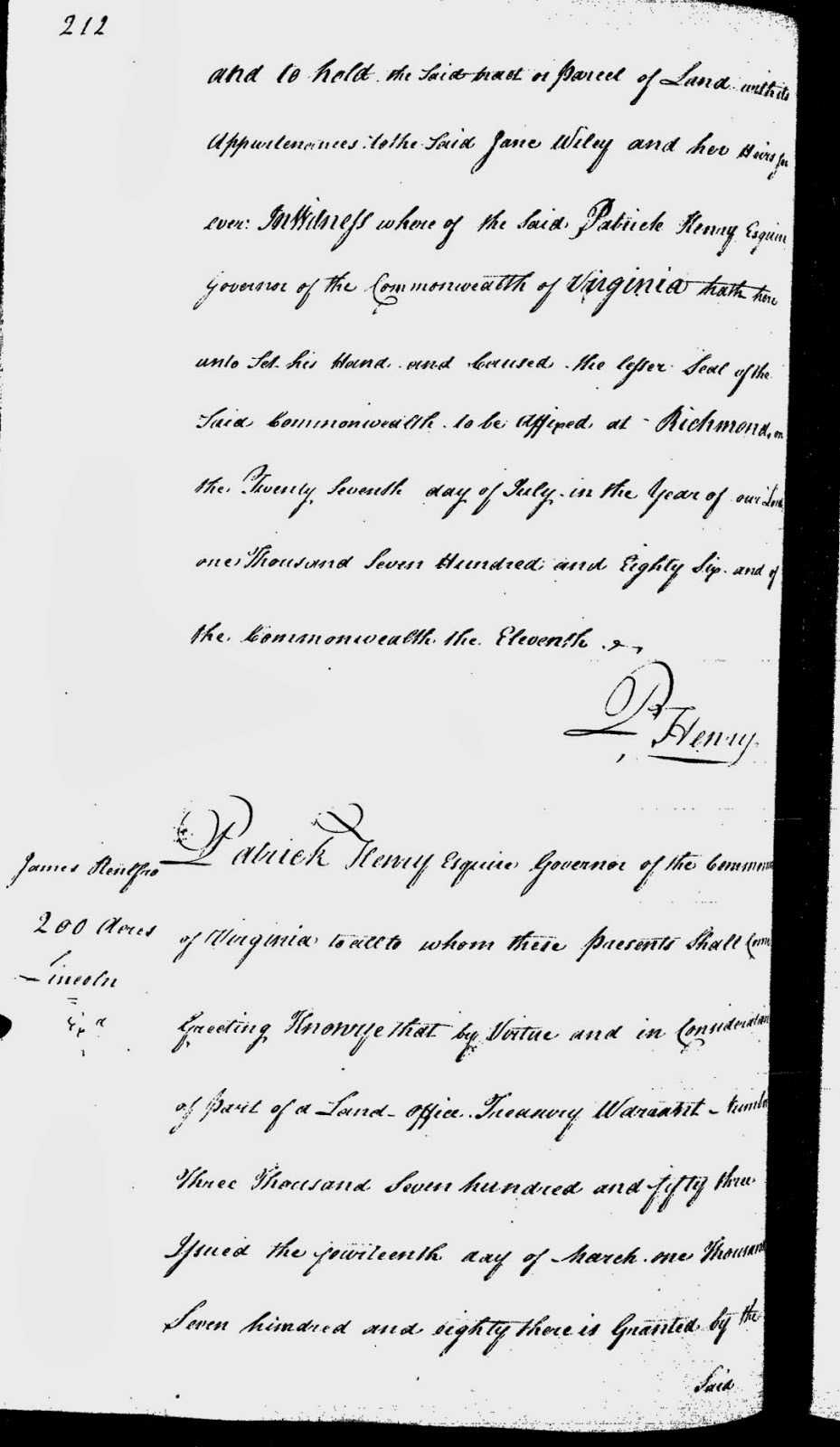


It included a land survey and on the Kentucky Land database a certificate that states it was once a grant to George Rogers Clark.


John Evan in Kentucky dug up some documents that showed Jenny Sellards Wiley and her sister Catherine Sellards Borders could read and write. They signed their names on several documents. Jenny signed her name "Jane Wiley".  So is this a land grant to our Jenny Wiley before she was attacked? If it were, why would she be getting this land grant? What happened to these lands?


So you see Ladies and Gents....the true story of Jenny Wiley has just begun. I am passing this knowledge on to inspire you to continue where I can not. Jenny Wiley deserves to have her true story told.

Find the real deposition of Jenny Wiley if it exists.

William Connelly Easley's records are scattered across the midwest. I have notes on where. They should be combed for his notes to see if anything exists of his interviews of Adam Wiley.

Discover the Wiley and Sellards family tree in Chancery, court cases, marriage and land records. Where did Jenny and Catherine learn to read and write?

More research on who was the Jane Wiley of the 560 acres Kentucky land grant.

Try to identify the Indians that did this attack and understand the Native American's reason for it.

Take each part of the Jenny Wiley stories and prove or disprove whether it is true or not.

Let me know what you FIND!

One more item. I believe Thomas Stuart Walker's lands that mentions Thomas Wiley's land border, were very close to an old church that the building still exists on 61 called Nebo. That is on the Bland  County side about a 1/2 mile from the Cove Road. Many years ago I researched the Thomas Walker family of Clear Fork (Distant kin to the Thomas Walker of Walker's mountain fame) and located the lands for the family. This Walker family donated lands for the church and here is a deed where his corner is at Thomas Wiley's.


I usually go over this couple of times again.... but folks....I am exhausted. The old ticker is flip flopping and I ache like a toothache. Jenny Wiley needs to be left with those who are in better health. There may be errors just contact me and point them out. I probably won't post again for at least another month or more. It will take me that much time to rest and to recover. Going to take me that much time to clean off the bed and put the books up!!

Books I recommend
"Early Adventurers on the Western Waters" Volumes by Mary B. Kegley and F.B. Kegley, Green Publishers, Inc. Orange, VA

The American Revolution in Indian Country: Crisis and Diversity in Native American communities, by Colin G. Calloway, Cambridge University Press

The Ambiguous Iroquois Empire: The Covenant Chain Confederation of Indian Tribes with English Colonies from its beginnings to the Lancaster Treaty of 1744  By Francis Jennings, W.W. Norton and Company

Stories of Jenny Wiley: Exploring the History and the Legends, by Todd Pack, 2013, Published by Story ATOM Media

Friday, November 8, 2013

A Place Called Wolf Creek Indian Village Part 4!

It's been a whirlwind few weeks. Sadness in the local community of losing neighbors and friends, my birthday, (in my mind I'm 20, and my body says, "YOU WISH!),  doctors appointments and just trying to live and function the best I can with these "illnesses". 

This is the Fourth post for the Wolf Creek Village series of my blog. I have learned so much from that place that I'm sure it won't be the last mention of it.

Inset from John Smith's 1612 Map of Virginia
When I first became involved with Wolf Creek Indian Village, I began as a guide. The first thing they did was give you a leather costume and sort of tried to dress us up like what an Indian might have dressed in 500 years ago?  Yeah, my thought was how accurate could we be with that?  Especially when all the documentation in the early reports shows Europeans had a perception of the first Natives they encountered to be "savages" mostly because of their custom of dress or lack there of. Such can be seen in this depiction of Powhatan people from John Smith's map of 1612.

To see the entire map click Virtual Jamestown John Smith's Map
I'm trying to find the documentation of Pocahontas. She was recorded as a nine year old doing somersaults in Jamestown not entirely clothed. So dressing guides authentically as they did 500 years ago...sketchy at best, and probably would have had guides arrested for indecent exposure especially in the summer.

The purpose to dress guides and have them "play Indian," was for tourism purposes only. Because when people think of Indians or Native first people, they think of leather clad and feathered Indians of the movies. So much so that in reality, the differences in tribal clothing are so numerous, it is hard today even for REAL native people to wear their own real clothing and be accepted by the general public. Most judge Indians by the perceptions that were given from the movies. 

I know of one chief of an Eastern tribe who sent his children to college on money he made wearing a Plains head dress and charging to have his picture taken. He told me it is because the general public would not recognize the real head dress of his tribe but expected all Indians to wear the plains head dress. He wore the Plains head dress all the way to the bank.

My first Wolf Creek costume was leather pieced together in a hap hazard fashion. What I called "cave man" clothes. It was a requirement of the job to, "play Indian".  I fought this requirement so long it was unreal.  At one time I was threatened with firing if I did not wear the costume. It was that bad. I had to relent if I wanted to stay at Wolf Creek. There were many more reasons to stay and wear the costume.


So I tried to at least make my costume one that would be believable for a later time period of Eastern Woodland tribes with a more modest skirt, a cape and fringe. Fringe had a purpose and was adopted by the Long hunters for use. It was also recorded on women's dresses in the 1600 and 1700's. At least I wanted my costume to look more finished than cave clothes.  I had to prove that they could have fringe at the time of the village with no metal tools and I did by making it with a sharp rock.

The costume was not "regalia". Regalia is much more sacred than that. Regalia has a personal purpose, most times a ceremonial tribal meaning and affiliation. Some folks told me it would be regalia because how the dress was made out of leather. I have leather shoes and a leather pocketbook and we don't call those regalia.

After many years there, I successfully petitioned the powers that be to get rid of the costumes for the guides. Instead to invite real Native Americans to WCIV and let them teach about their culture, their tribe and their regalia.  After we put on uniforms, you still would not believe how many times I would hear when a visitor came through the gates of the village to ask, "Where are the Indians?" and I would ask them, "What does a real Indian look like?" And I would get the answer, "You know feathers and leather."   Though it was daunting, I took it as an opportunity to educate about the first people here and why we should not dress that way.

I had many experiences while in costume. Some visitors would actually talk down to you as if wearing that costume made you less than human. That was something I didn't experience in regular modern clothes. The prejudices against Indians really showed. Others would treat you with this mystical reverence that was bordering on, if not completely, CRAZY!

I once gave a tour to a man and after he finished, he said he planned on returning with his family. That he was very impressed with the tour. The next week he shows up with his "family".  A group of about 9 people, none really related when they introduced themselves, in which some were dressed with Egyptian type make up and carried staffs. It was all very strange.

What unnerved me after I gave them a tour was they said their purpose was to take "me" back, right then, that day, to their "shaman".  That their shaman prayed about it and said I was the person to lead their people on the journey to the "center of the universe".  Wherever we are, we are the center of the universe, so I had no idea where that journey was going to go!!!

That I was to live with their people and to teach them how to live without all the modern conveniences. This included teaching them about natural medicines. In their group was a lady that had Parkinson's disease and she was quitting her medications that week. It was so alarming! This occurred about the time of the Heaven's Gate cult out in California, so I always called them the Heaven's Gate visitors.

I was stunned!! Bless their hearts. I'm not even the guide who taught about natural local medicines at the village. I just looked at the group and asked them, "It's the outfit, isn't it?" and told them, " I'm sorry, but I'm not going anywhere with you. I go home to a microwave and electric heat."  The group was actually waiting for me at the gate at closing time. The director had to threaten to call the police to get them to leave. I was terrified driving home and for about a couple of weeks afterwards I was so much more cautious, making sure I wasn't going to be kidnapped.

This was just one incident. But there were many more positive visitor experiences. Many Native American Indians, not only graciously shared their how-to craft knowledge and history, but also brought back their families for a history lesson that the village itself taught. That was an HONOR!!!

The first group of guides Wolf Creek Indian Village hired were artisans.  We were teaching, "living archeology." We actually recreated the artifacts found using the methods the first people would have had available to them to furnish the displays in the village. We had a basket maker, a flint knapper/fire maker, a potter, hide tanner, tool makers and gardeners.

I began as the basket maker, then the potter, learned to tan hides, make bone tools, garden, (we talked about agriculture) and discussed different gardening methods as shown used by different archeology sites. We used the 3 sisters method for gardens around the village. We would take in "road kill" that would normally be taken to the dump. We used it to show how adept the skills of the first people were at processing animals using just rocks, no metal. We were teaching about the original village, the environment and the skills one would need to live there.

Oddly enough, if you go back in time far enough all over the world, people developed the same skills. The argument comes from why did the first people here not have iron?  Why were they not, as what is thought of as, "developed" as those from Europe.

I once saw a gold bead from a long string of beads, under a magnifying glass the Mayans or Aztec had created. It was the size of a pencil lead and had intricate designs carved into it and was absolutely amazing in detail. People who could create something so tiny and so perfect shows the technological abilities of the people on these continents were not primitive.  Their stonework rivals anything in Europe.


Reading about Cahokia Mounds I realized that it was a civilization that existed for over 100 years, much in the same way civilization ebbed and flowed in the old world.  I realized the first people did not lack anything that Europe had. They had technology, trade, government and agriculture.  I believe after working at WCIV for so long, what I had learned is the reason the iron age wasn't developed is....... because it wasn't needed.  That is, until those who had that technology, showed up.

My next post will be about my partner Eddie Atwell. I met Eddie when he was the head guide at the village. There were other artisans that began with WCIV but this mountain man stayed and it's his knowledge of these skills, which he gladly shared, (and others would take to developing to an art, like Sam Wright) that helped put WCIV on the map.

This picture to the left is the new uniform we wore and at the end of that rope was a small bear that had been hit on the interstate by a car. Brought to us by DOT personnel. We had permits and we processed and tanned the hide for an educational display. Most children never get to touch bear fur or touch to see how long even a bear cubs claws can be. At Wolf Creek they did.

Since it's fall, I have an apple cake recipe to share, that will be next and then a blog post on Eddie.

A Place Called Wolf Creek Indian Village Part 1

Thursday, October 24, 2013

A Place Called Wolf Creek Indian Village Part 3

So Part 1 of Wolf Creek Indian Village was about the Archeology dig. Part 2 was my first encounter with the village personally. Now Part 3 brings it up to today and some of lessons learned. There will be more blog posts to expound on what I have learned.  I have to apologize that I am not a prolific blogger. It takes me some time to get these blog posts up. Those that follow my blog, know my illness really stops me in my tracks even on the best of days. If I have other duties then I am truly spread thin.

I use the spoon method with this CFS. Imagine each activity you have to use a spoon and each day you are given only 1 to 4 or 5 spoons (depending what symptoms you have) to use during the day and when they are gone, you are done. I try to gauge what I can do because if I go over, I'm crashed for a day or two and have no spoons at all!! But let's forget about that and talk about Wolf Creek Indian Village.

In the late 1980s, the Bland County Historical Society under close direction of a man by the name of George Schaefer, the first director, purchased what was left of the property after Wolf Creek was re-routed over the archeology dig.  They decided to create a museum dedicated to the village and actually reconstruct the village 200 feet from the original site. It was a monumental task but they did get a reconstruction of the village built in 1996.


First Reconstruction
I remember the first time I saw the village in 1998.  I was on my lunch break from working for a pharmaceutical company selling legalized drugs and the museum had an open house. They did not have the main building open or completed yet. The museum was in a trailer. Walking down the path to the village was like walking back into the woods in time and then at the end of the path was an entirely different world.

It was the size of it all, the palisade, the creek, the smoke in the air from the fires. I was taken back for sure.  Just being on that creek was like coming home. Made my heart beat hard. I didn't remember a thing the guide told me. I was trying to remember the original dig and where things were placed.

 It was a year later when I was running my own historical genealogy business that I volunteered for the village and then was hired as a guide.  I would not leave for 12 years. Being at the village taught me so many lessons about Native Americans and their history. About my own family history and my place today. 

But the FIRST lesson of Wolf Creek I learned is how much we have changed the environment to the point we can't build a proper village. Anyone who says that man has not had an effect on the environment should try to just build one simple, proper, structure like the first people had in this area using natural resources around us. JUST ONE, much less 10 and a palisade.

The first people here were masters at using the resources surrounding them no matter where they were in the US.  In building one structure it will surprise you how much of our natural resources are now gone or changed in Appalachia. Those resources changing and disappearing mean we can not, without a great amount of cost of transporting from outside the area, recreate what they had.

Appalachia has lots of forested land but it has been timbered to the point that what is growing today the trees are actually toothpicks compared to what was once here. Flora and fauna have changed. There used to be a plant called river cane (which is North American bamboo) and reeds, growing along many creeks and rivers.  In some instances we would have to plant and wait for the growth of plants to use what the first people would have found plentiful in Bland County.

The second most important lesson that Wolf Creek taught me, was how Native Americans are perceived to live from the past to the present. People argue over the correct way to build structures from an age when no one was there to record it and how to represent that history.

On the reconstruction, with the archeology dig, what we had that most do not, a map. The archeology map had the post holes of the original structures laid out by what was found. It was used as the basis for the reconstruction, twice. We knew what was found in the ground. What we didn't know was how that information transfers to recreate what was found.

This effected how to build the reconstructed Indian village. The first structures of the reconstruction were made like wigwams, because those consulted said these structures at this time period would have been wigwams. They were built to the diameter and setting in the places of some of the main structures Howard MacCord had mapped out on the original archeology dig.

These first recreated structures were shaped sort of like a wigwam, and covered with a fiber glass material coated with polyurethane resin. It was decided to construct the village this way because to have this many structures covered with large pieces of bark would have been difficult to maintain, killing many trees for the bark, as well as it being too dark inside, for displays. For a view of this first reconstruction here is a You Tube video.

The wigwam design worked in two ways. The structures did represent a structure on the map and they did fit the need for the "perceived" idea of what a wigwam was.  But these were much taller than normal wigwams and actually resembled more tall tee pee type structures. In an odd way they were accepted easily because people thought natives lived in a tee pee from TV. Wigwams, long houses and tee pees are the only structures most folks recognized, though Native Americans across the continent used many different forms of architecture.  The palisade was constructed of locust posts. The palisade, combined with these structures, though not accurately made but accurately placed, was awesome. It was the aura of the village size that made it impressive.

The layout of the village itself is what makes the reconstruction, regardless of how they are built. The original was said to have 60 to 100 people living there. There were times during the upkeep of the village I wished we had that many hands to maintain it!

Flooding over the years and the placement of the village near the re-routed creek caused significant damage to this first reconstructed village. I have seen the water from the creek up in the village over 3 feet high. Howard MacCord in his report talked about how the original site did not show evidence of much flooding. But with the removal of trees and the changing of the land over the years flooding now normally occurs on Wolf Creek on a regular basis. By 2008, flooding had weakened and taken out so many of the original reconstruction. There were only 3 of the original rebuilt structures left and only 1 could be used.

In 2008, the Bland County Historical Society sold the village and museum to the Economic Development of Bland County. First order of business was to reconstruct the village and yours truly is responsible for its design today.  The process was a long, exhausting research project that taught me many lessons. I talked to so many people; archeologists, historians, different tribes and tribal members. I went to other reconstructions such as Cherokee Oconaluftee village and looked at other sources. Too many to name right now as I left that list at the village.

Under the direction of Director Sam Wright, we begin the rebuild the second time. In the end, we went to the original archeology dig and the archeological notes of Wolf Creek village itself as the main source. The map of the village told us how it could be built today. What I saw was a village constructed pole for pole. Where the ancient ones put a pole, we put a pole, even if we didn't know what the pole was for.

There were still those that insisted it should be wigwams. We had friends who are Ojibwa and Cree from Canada who still build wigwams that I consulted with. When they visited they kept saying the structures were too large to be wigwams. Looking at the map they kept saying there were too many poles and the structures were too large for them to be wigwams. If not wigwams, what were they? They were not elongated like long houses. They were round! Great site about Objiwa Wigwams

In Cherokee they spoke of wattle and daub round houses. In Cherokee I learn they would use river cane splits or saplings and cover them with clay. These structures made much more sense to have been at Wolf Creek than a wigwam. In the early documents there were recorded reeds and river cane in our area. First European settlers and farmers complained about it. They fed their livestock river cane shoots and dug it out to get rid of it so they could get livestock to the creek.

We actually have planted a small patch at Wolf Creek. It is not along the creek but in the wetland, because one of the farmer's complained about it to us when he learned we planted it. He warned us that if it gets out of hand, his great, great, great grand daddy said it spreads like wildfire and he would never be able to get it out!

In the archeology notes, Howard MacCord complained that there was this heavy clay mud at the dig that every morning the volunteers would have to go to the creek and wet down the area where they were working to get to the feature's post molds.  Just up from the village there was a pottery operated in the mid 1800's with clay found on site. I am more than certain that with this info that these structures were not wigwams and probably were round houses. So I followed the map and measured out where the poles would have been, placing an orange flag for each pole and that's how we built what is there today.

I had a very dear friend who was a chief that was quite upset with the rebuild. He insisted on wigwams, he insisted we had too many poles, told me of other structures to include and to move fire pits to different places. I politely told him we were going with pole to pole construction and if he wanted, he could tell the ancient ones they put in too many poles and the poles and fire pits were in the wrong place in the village.

It was like a light bulb went on in his head. Then and only then did he understand what we saw the village as and approved. We still had to modify the doorways to allow for disabled access. We call that building an ancient village open to the public in modern times. The doorways were quite narrow and we left one as an example.

Mike Barber, the Virginia State archeologist, put out the possibility that the extra posts were replacement posts. If the village only existed 5 to 7 years, it didn't flood, what would they need to replace? What damaged the first reconstruction were flood waters, hitting the coated wigwams and ripping them basically out of the ground, not rotting in the ground.

Now could we build the village wattle and daub?....NOPE! The re-routed creek, unlike the original creek, floods on a regular basis and with that many structures a decision had to be made, since we didn't have the 60 adults of the original village to rebuild if it flooded, how to construct it with out much maintenance costs. Even the matting on the inside is placed up higher to avoid the flood waters when it floods.

But Wolf Creek Village teaches this comparison contrast between the past and the present. One of the basic tenets in most Native American teachings is the taking care of the earth. That the earth itself is not an inanimate object but a living being on which all life relies and when we destroy the earth or abuse it, we destroy ourselves. The story of the village and reconstruction is teaching the effects that man can have on the land today, in a big way. Man is learning a hard lesson in that we have to work with Nature not against it.

The village today is almost complete. I had wished to be a part of it for years to come but alas that was not to be. But the village lives on as the spring board of the comparison contrast between the past and the present story of Native Americans in our area. That is it's greatest strength as a museum.  Especially with so many Appalachians claiming native ancestry still, it was the place I begin to understand that belief, the myths and the work to uncover the real history.

My next blog post will be, "Where are the Indians?.....What does an Indian look like?" where I will discuss playing Indian, quantum blood, effects of treaties, removal and my own family history.

A Place Called Wolf Creek Indian Village Part 1

A Place Called Wolf Creek Indian Village Part 2

A Place Called Wolf Creek Indian Village Part 4

Wolf Creek Indian Village and Museum

Wednesday, October 16, 2013

A Place Called Wolf Creek Indian Village Part 2

Where to begin with my relationship with Wolf Creek Indian Village? Those that know me personally, know I along with MANY, MANY others, have a very long history with the land the village is on and sort of the beginnings around it. Long before it was ever built. I could and probably should write a book on it all but I think I will just stick to the museum village itself.

Many GOOD people put in a lot of hard work and brought the museum into being. To this day, each successive crew of staff and volunteers that have worked there, have in their own way, made it better. Each like a bead in a story belt they are each a part of the whole. I'm really grateful that the history of the village continues at the museum today.  But it could take volumes to tell of so many and really I can only speak about my own experiences with the village.

The events and how it first began were a little rocky but that's for possibly a blog post that deals with economic development in the mountains, not necessarily the village or the museum. But this is about the village and what it has taught us and specifically me, about Native American history in the mountains. Instead of a 2 part blog post I believe this will be 3.

My first experience with the village was at the archeology dig itself. My dad had retired from the military in 1970. For an entire summer we went camping. We camped a lot when I was growing up. My dad, in the Army in World War II, had been forced to camp and he believed his children needed to know how to live that way too. After seeing many cities and towns in Europe just decimated and people having to live out in the open, he was very adamant about it. It's sort of funny how that also prepared me for my outdoor job at Wolf Creek.

When Howard MacCord was initiating the dig of the Wolf Creek site, we were camping in Grose's Bottom which is right next door to the museum. Ben Grose, whose family owned the adjoining farm for generations, would rent out this pasture on his farm located next to Wolf Creek for folks to spend the day camping, or for a picnic for 50 cents a day. It's the same place my grandfather Bane Boyles dies in 1975 fishing on the creek bank. There is a overhead view picture of the village dig from the Virginia Department of Historic Resources and on the adjoining farm, is a very small white car at Grose's bottom. This is my mother's white Studebaker station wagon parked next to the creek at our camp site.

In May of 1970, while camping at Grose's Bottom we knew about the dig. Everyone knew about the dig. Howard MacCord made sure of it. In order for him to pull off this size of a dig in such a short time, he relied on local volunteers. It was in all the local newspapers and after digging all day he would go in the evenings and speak to groups about the dig canvasing for more volunteers. As I said in the first post, though the methodology might not have been up to archeological standards of today, what he did was a miracle.

I was in my early teens. I had never seen an archeology dig in my life. We started camping at Grose's Bottom probably 3 or 4 days after the dig began. When we walked over to the dig, I wasn't sure what I was looking at. Just a lot of bare earth. There were dark patches and pits and opened graves. The bones in the ground were a bit upsetting. I had never seen that before either. Grave yards were sacred grounds to me even at that age.

But there was this man, taking time to talk to all the visitors while he was working about what we were seeing and what he was trying to do, what he was trying to save. The dark post hole molds where Natives charred the ends of the posts before burying them showed on the ground in a round pattern indicating a house. The fire pits with charred rocks, how they were arranged showed how they could have been a documented way Natives cooked meat.

As he spoke, I didn't see bare ground anymore I was imagining and seeing the village he was talking about! He spoke to us of the value of saving what we were seeing. That this was history written in the ground. Those were his words and later on I would use those words to teach thousands of school children about archeology.

Howard MacCord talked about the highway coming through was going to put the evidence of this entire village under the creek and destroy these bones if they didn't get them moved. He then showed us how they were documenting all they were finding. He motioned us over to the pit he was working in which was a woman's bones.  He handed me a soft brush and showed me how to gently brush away the dirt without disturbing the shells beads she had been wearing. Something happened that day to me. I have to say that was the "DAY" I became a student of history and started a life long pursuit.

Now today, I understand the controversy of archeological digs on ancient sites. I feel it in my heart too. Especially from those of the Native American communities. But the Ancient Natives themselves inhabited and re-inhabited sites in the mountains. With our population, and geography there is no way sometimes to just leave things as they are.

In Wolf Creek's case they could have just built another bridge and today if the highway was being built, they "might" have done just that. Of course cost overruns and debt speak doesn't guarantee that any site will be saved. So what can you do? Except to document and remove what is in danger of being totally destroyed and annihilated from memory in the ground. The laws today are better at protecting new sites and with each site discovered new history emerges. The story in the ground of the first people has much yet to teach us.

That night back at camp was the first time I heard my mom and dad speak about that side of our ancestry. Almost in hushed tones. First time I heard my dad say, "We don't speak about that because it's worse than being black."  It took me YEARS to discover the stories, as to what impressed upon him that belief and why he thought that way.


He with his parents, grandparents and great grandparents lived through times, unlike today, that it was thought not to be good to be Native or have ANY Native ancestry. They lived during a time popular history books about the settlement of our area began to focus on wars with Indians that produced "massacres".  Yet they forgot to mention the massacres on the other side. No one plays nice in a war! His great grandparents lived after the Civil War when fighting the Indians out west produced the motto, "The only good Indian is a dead one".

Besides no one with Native ancestry was suppose to be left in the mountains anyway, they were all "removed". They could say and make believe that until he with his parents and grandparents suffered through Walter Plecker and the Virginia eugenics movement. Yes, there will be more blog posts.

That night I dreamed about the village. I saw two men and a woman, not dressed like any Indians I ever knew from TV, coming from the village site, walking like floating over the waters of Wolf Creek by our camp site and vanishing into the hillside above Grose's bottom. I actually got up and went outside the tent and looked. It was really dark and all I could hear were the night critters and the creek water over the rocks.

I went back to sleep and I dreamed there was singing, drumming and laughing coming from the village site and I was moving towards it. I never got there in the dream. It was a long, long way off.  They were not scary dreams just odd ones. Dreams I'd forget about because that was 1970 and I didn't remember until I return to the reconstructed village in 1999.

Wolf Creek Indian Village and Museum

A Place Called Wolf Creek Indian Village Part 1

A Place Called Wolf Creek Indian Village Part 3

A Place Called Wolf Creek Indian Village Part 4

Wednesday, August 21, 2013

Appalachian Native American Stories to Tell


There is one area I will be delving into in the future and it will not be easy. Not only because of the shape I am in, but also because it is a part of history that is just not easy to research or tell, but it's on my heart. That is what I know about the history of Indians in Appalachia.

A Native friend called me today and asked me if I had seen the special on C-Span about Werowocomoco Village. Powhatan's chief residence that was recently identified in the last 10 to 12 years. They are preserving and studying the site which is located on the York River and is SUCH an important historical site for Native American history in Virginia. Most of the tribal chiefs of the state tribes in Virginia were there at this event whose tribes were once part of this federation of tribes that dealt with the colonists at Jamestown. It brought up the remembrance of a long neglected history of our Appalachian mountains.

How many of us have the oral tradition that we had ancestors that were Native American? Yes, I know, there are many who laugh at that. Mainly because all we have are stories and not the actual proof of that history. Though DNA is helping. It is always told to be Cherokee, which those in the Native American community ridicule each time they hear it. I understand, but the history of the Cherokee in this area is pretty predominant. John Ross, one of the chiefs of the Cherokee at the time of removal in 1836, was actually 3/4 white and many were especially in the North Carolina mountains connected to that tribe.

I also think some of that is because in the early 1900's the Cherokee plight became so well known that the actual history of Native Heritage became mixed up with, "they had to be Cherokee". So many of those who did have a Native ancestor in the mountains had become so assimilated into white culture. They did not know the history that so many tribes were wiped out of existence. They didn't understand that the Cherokee were not the only tribe here or connected to Appalachia. 

It is also talked about as if it was most recent. When it could have occurred generations ago before the removal policies. It is also hard for those who are west of the Mississippi, in a later history that included segregated reservation systems, to comprehend what it was like to live in the East prior to and after those removal policies. But those stories need to be told.

In my own family it was something not to be talked about but more to be feared if it was found out. We knew and that was enough. In Virginia especially there was the assimilation with not only white but black ancestry with the persecution that follows that.

Natives were people of color.  I once was helping a woman trace her family tree. In some of the records she found, their family would be listed as white. In others listed as black or mulatto.  She did trace to some Saponi names but was quite upset when I told her they would be at times listed as people of color. She told me, "Those records could not be my family," because, " my ancestors were "white" Indians!" 

I really don't know what that is. Though it's popular today to claim Native ancestry, it is hard to get folks to understand this aspect of who they were and the times in which their ancestor had to live.

Mary Kegley wrote a wonderful book entitled, "Free In Chains", the story of Rachel Findlay who was Native American and enslaved. It is the story of Rachel and her family going through Virginia courts to gain their freedom before the Civil War. It is hard for some to come to grips that Virginia Indian history is tied to black history.

The records of Virginia and America still need to be combed to find and verify the history about Native Americans in Virginia and the mountains. It would also have to be an international search with England and France records, prior to the Revolutionary War. Plus we know there was a time in Virginia records were destroyed to hide native ancestry.

The history of the Native Americans in Virginia is a very long one and in modern times very much tied to race issues. In Virginia, we have a history of eugenics in our state government that had a big impact on Native Americans in our state.

But they are STILL HERE and we who are descendants are still here! The Virginia Indian Tribes the Pamunkey and the Mattaponi actually have the oldest reservations in the United States but they are not recognized by the federal government. They have fought to keep their culture and history.  An interesting article click here for the Pamunkey. One of the best sources about Pocahontas's people is to read Helen Rountree's works. But we are in the mountains and that story is just not yet written in it's entirety. Historians and researchers today are only scratching the surface.

I remember as a child looking at maps of where the Native Americans were located in the United States and always so disappointed because our part of Appalachia would say, "Unknown Tribes". In my research I have found it wasn't as much an uninhabited "wilderness" as once thought.

Wolf Creek Indian Village and Museum, where I worked, was based on an actual archeology site in Bland County. It was the first state recognized archeology site in Bland County but didn't occur until 1970. We are way behind the coast of Virginia on documentation and archeology in telling the Native American story in Appalachia.

I hope in the future to tell the story of what I know about Native American history in Appalachia, but this Chronic Fatigue Syndrome is an awful disease. No two ways about it. It has robbed me of so much. There are days when I can hardly move, days when it is an effort to get dressed or do the simplest of things. Days when the sun is shining and I want to do SO MUCH and the old body just won't cooperate. I fight it every day and I can tell you it is no fun to feel like I have the nightmare of this achy awful flu that never goes away.

This blog I have to say is kind of a saving grace. You see, I was just laying around, trying to figure out how to get better. A lot of times just in tears because I just felt so worthless. I felt I had become this shadow of my former self. Days turned to weeks, that turned to months and now a couple of years since I felt really well. The internet and TV were all I had. This spring, when I found my blog again, that I started before and just as I got ill, I thought ...ok I will just share a few things on it and tell some family history to see how it goes. It will be something to do, other than cry and watch T.V.

Little did I know that it is has become something I can put my attention on, rather than just laying here hurting and being sick.  Even when the illness is so bad and I can't even think. At those times I don't write too well I have to go back, edit, over and over again. But I feel I'm on a mission once more.

If you all see any sentences that are backwards, literally, please tell me. My thought processes with this disease are really weird to me. But though it is a real challenge to do this, it's giving me new hope. That my life is not over. I'm not totally useless.  Especially the nice comments I have received from readers. SO THANK YOU! THANK YOU ALL.

I can't be as prolific a blogger as some. This week will be 3 posts...whoo hoo.... been the most I've ever accomplished.  I know I have several hundred articles in me with added recipes and crafts. Yep, I can keep this going for quite a while.

I don't know how much I can do these days to expound on these things. Being ill has hampered me in more ways than one. I miss the ability to do my job and I really miss my job MONEY!  I will be limited to research on the internet, and as long as I can keep the internet on, it's a story I will surely try to tell.   I hope you will join me for the journey.

Copyright 2007-2016 Denise Smith